
How to Tape an Ankle for Athletes (Basketball, Soccer and More)
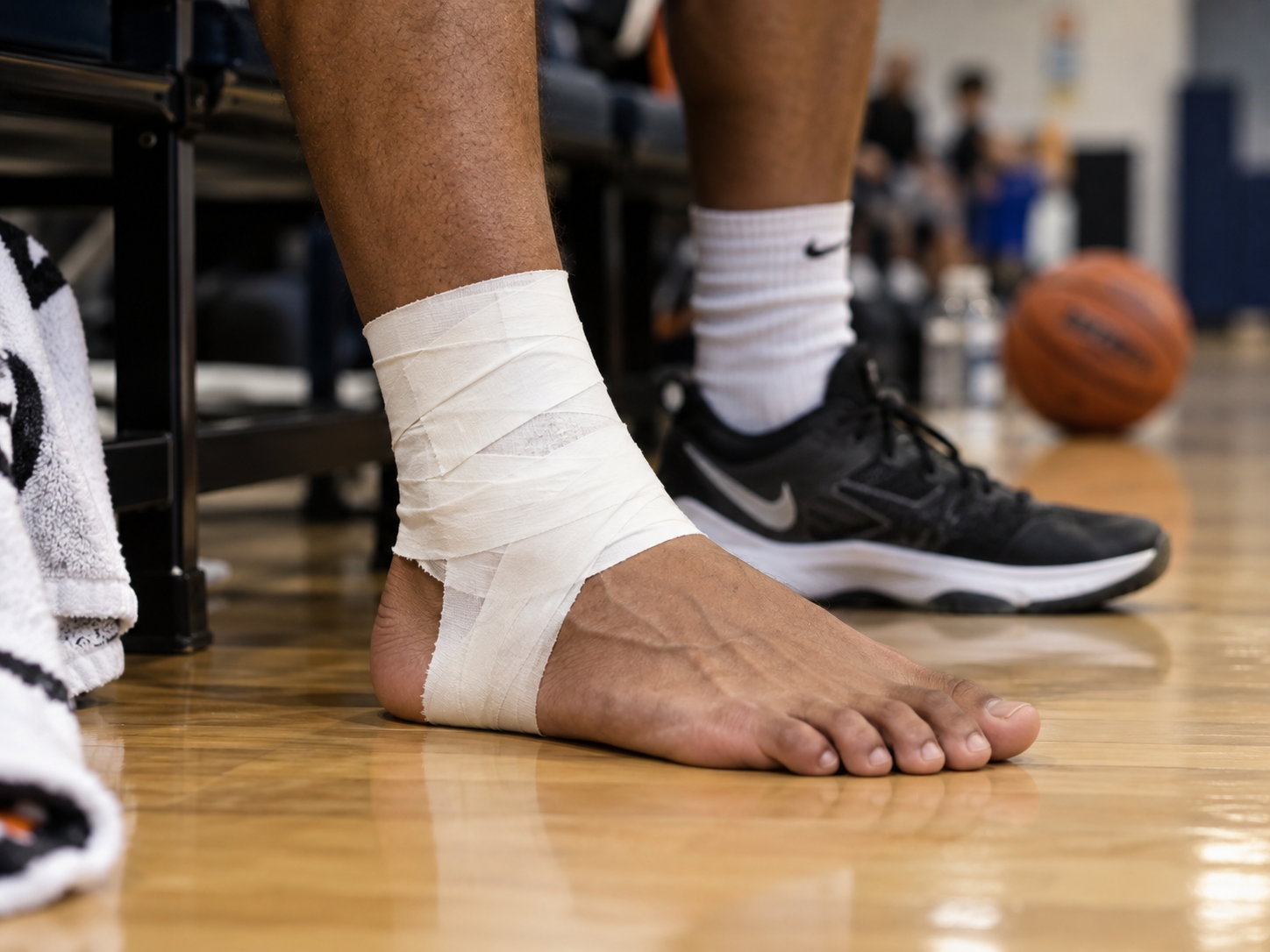
This article is for athletes, coaches and parents who have dealt with, or will deal with, ankle sprains in sports. You will learn how to properly tape an ankle, and the best practices for ankle sprains.
1. When and how to tape an ankle
You've sprained your ankle and now you're out for a few weeks. Bummer! But know that it's very important to get a proper assessment by a physiotherapist to find out how severe your sprain is, what to do to heal properly, and which exercises will help you return to play safely. And another thing: your physiotherapist will guide you on WHEN it's SAFE to go back to play.
In my experience, ankle sprains are one of the most neglected injuries. A lot of athletes go back to playing way too soon, when the ligaments aren't properly healed and the ankle isn't strong or mobile enough. You may think you're ready to play, but going back too soon can lead to recurrent sprains.
When to tape your ankle
Ankle taping can be effective in a few situations:
- When your sprain is fresh and you need some support and pain reduction to walk. We usually combine taping with compression to help reduce swelling, or suggest a compression bandage instead.
- When your physio says it's safe to return to play. Taping can help you feel more protected and offer a bit of stability while your ankle isn't yet back to its full strength and proprioception.
- If you've had a severe sprain or multiple sprains in the past and you want to prevent future sprains.
How to tape an ankle
You will need:
- Zinc tape (rigid sports tape)
- Pre-tape (underwrap)
- Pre-tape spray (optional)
We suggest practising ripping a few pieces of tape before doing the actual taping. We actually practise this in physio school, because it's not that easy at first!
Watch the full video to see the ankle taping technique. This technique is recommended for return-to-play taping and sprain prevention (situations 2 and 3 above).
2. Is ankle taping the best way to prevent future sprains?
According to studies, ankle taping can be a great way to prevent ankle sprains. But there is one consistent message: taping should NOT replace proprioception and strength exercises. Taping can help prevent sprains, but if the athlete has reduced proprioception and strength, the risk of spraining the ankle can remain high, and they can experience recurring sprains in the future.
Ankle taping or bracing: which one is better?
Both ankle braces and taping reduce the risk of ankle sprains, especially in athletes with previous injuries. Neither has been conclusively shown to be superior for preventing recurrent sprains, but ankle braces are generally more practical and cost-effective (no need to keep buying taping material).
3. Taping is a small part of prevention: what actually works?
Taping should be secondary to everything else you can do to prevent ankle sprains. First, if you've had a sprain, make sure you're properly guided by your physiotherapist with strength, proprioception and mobility exercises, and only go back to play when you're cleared to do so, when it's safe.
Which exercises help prevent ankle sprains?
There are tons of great exercises, but here is what the science recommends:
- Single-leg balance on an unstable surface or with perturbations
- Ankle and lower-body strengthening
- Single-leg hops and agility exercises
- Ankle dorsiflexion mobility, especially if mobility is restricted
My two favourite ankle sprain prevention exercises
Here are two of my personal favourites as a physiotherapist, to do towards the end of rehabilitation or for prevention. Always make sure these exercises are pain-free.
1. Single-leg calf raise (without holding on)
Standing on one leg, rise up onto your toes, hold for 1 to 3 seconds and lower back down, without putting your other foot on the ground during your reps.
3 sets of 8–12 reps per side
2. Single-leg cross jumps
Stand on one leg in the middle of an imaginary cross. Hop forward, landing on the ball of your foot (heel not touching the ground). Hold for 5 seconds to stabilize, then hop back to the centre. Then hop to the right, backwards, to the left and forward again. Always hold about 5 seconds after each landing: this is a stability exercise, not a speed exercise.
3 sets, twice around your cross
Prevent ankle sprains with PRO ATHLETE
Download the PRO ATHLETE app for free ankle sprain prevention exercises.
Frequently asked questions
How long does an ankle sprain take to heal?
Depending on the severity of the sprain, it can take anywhere from 2 weeks for a minor sprain to 3–6 months for a major sprain.
Can you walk on a sprained ankle?
Disclaimer: this is not medical advice. See a health professional for an assessment and the right advice for your sprain.
It depends on the severity of the sprain, your pain and the judgement of the physiotherapist who assessed you. General rules of thumb:
- If it's too painful to walk, use crutches or a boot to take the load off for a few days.
- If it's too painful to put any weight on the ankle, you might need an X-ray to rule out a fracture. Your physio will judge whether it's necessary.
- If it's a bit painful but you're able to walk, you don't need crutches or a boot, but it's important to limit walking to let the ligaments heal.
How do I heal a sprained ankle quickly?
You can't go faster than your body allows. The best way to heal as quickly as possible is to stop playing as soon as you injure your ankle, and apply general principles to reduce pain and swelling at the beginning. You should also be guided by a physiotherapist throughout your rehab and do your exercises consistently.
Going back to play too quickly can actually slow down your healing. Wait until you're cleared to get back on the court or field, so your ankle is ready for the demands of your sport.
Sources
- Delahunt E. et al. Clinical assessment of acute lateral ankle sprain injuries (ROAST): 2019 consensus statement and recommendations of the International Ankle Consortium. British Journal of Sports Medicine, 2018.
- Vuurberg G. et al. Diagnosis, treatment and prevention of ankle sprains: update of an evidence-based clinical guideline. British Journal of Sports Medicine, 2018.
- Dizon J.M.R., Reyes J.J.B. A systematic review on the effectiveness of external ankle supports in the prevention of inversion ankle sprains among elite and recreational players. Journal of Science and Medicine in Sport, 2010.
- Preventive interventions for lateral ankle sprains: a systematic review and meta-analysis. 2023.